

QMS Planning
The QMS Planning module centralizes the foundational strategic documents required by ISO 9001:2015. This is where you define the "why" and "what" of your quality system.
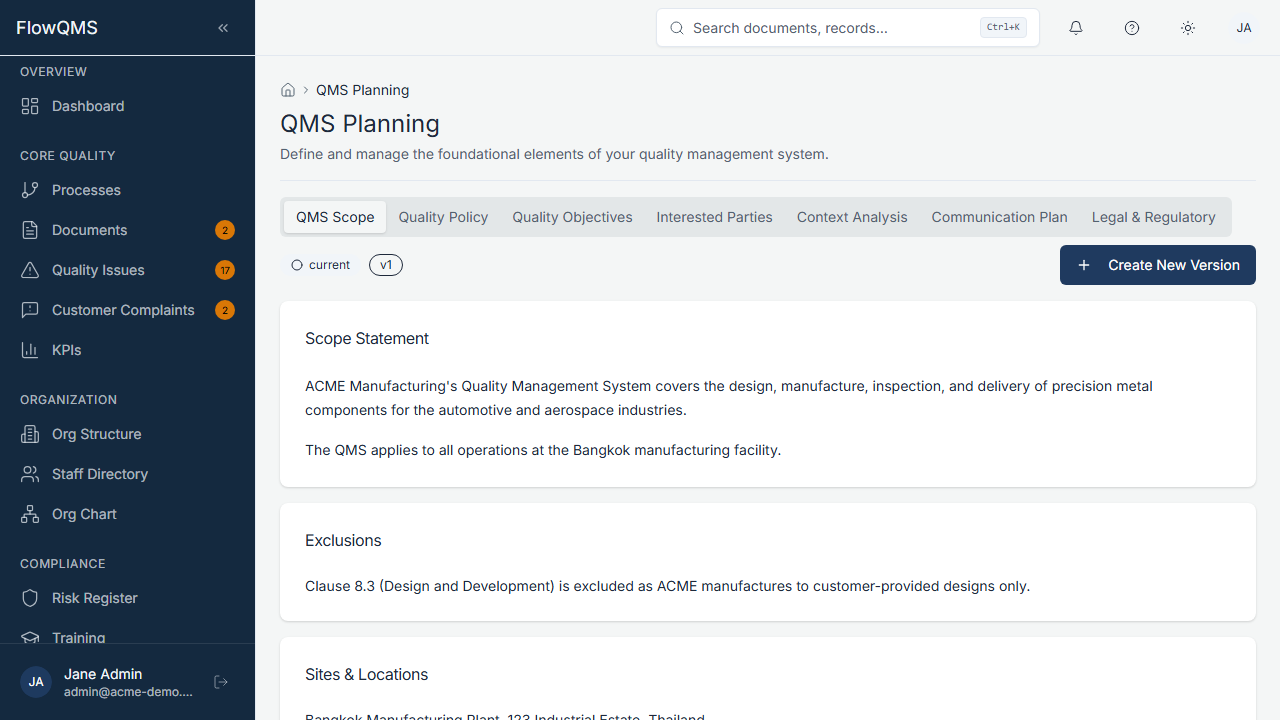
Sidebar location: Compliance > QMS Planning
The module is organized into seven tabs:
Scope Tab
Define and maintain your QMS scope statement.
| Field | Description |
|---|---|
| Scope Statement | Rich-text editor for your QMS scope (what products, services, processes, and locations are covered) |
| Exclusions | Any ISO 9001 clauses excluded, with justification |
| Applicable Sites | Physical locations/facilities covered |
ISO 9001 Reference
Clause 4.3
Policy Tab
Maintain your quality policy.
| Field | Description |
|---|---|
| Policy Statement | Rich-text editor for your quality policy |
| Commitments | Individual commitment statements |
| Communication Method | How the policy is communicated to staff |
ISO 9001 Reference
Clause 5.2
Objectives Tab
Track your quality objectives with measurable targets.
Each objective has:
- Code — Identifier
- Title — Objective name
- Description — What this objective aims to achieve
- Target Description — Measurable target
- Target Date — Deadline
- Responsible Role — Who owns this objective
- Status — On Track, At Risk, or Off Track
- Progress — Percentage complete (0-100%)
ISO 9001 Reference
Clause 6.2
Interested Parties Tab
Identify and manage interested parties (stakeholders).
Each entry has:
- Name — Stakeholder name (e.g., "Customers", "Regulatory Bodies")
- Type — Customer, Supplier, Employee, Regulator, or Other
- Needs & Expectations — What they expect from your QMS
- Relevance to QMS — How they impact your quality system
- Influence Level — Low, Medium, or High
- Monitoring Method — How you track their requirements
- Review Date — Next review date
ISO 9001 Reference
Clause 4.2
Context Analysis Tab
Analyze your organization's internal and external context using structured frameworks.
Framework options:
- SWOT Analysis — Categorize items as Strengths, Weaknesses, Opportunities, or Threats
- PESTLE Analysis — Categorize items as Political, Economic, Social, Technological, Legal, or Environmental
Each item has a Description and Impact Level (Low, Medium, High).
ISO 9001 Reference
Clause 4.1
Communication Plan Tab
Define how quality-related information is communicated within and outside your organization.
ISO 9001 Reference
Clause 7.4
Regulatory Register Tab
Track applicable regulations, standards, and certifications, and monitor your compliance status.
ISO 9001 Reference
Clause 4.2 (external issues), Clause 8.2.2 (statutory and regulatory requirements)